

In recent years, the term “narcissistic” has become increasingly popular online, especially in conversations about relationships, social media behavior, and personality traits. People are searching for its meaning because they want to understand how to identify narcissistic behaviors in themselves, friends, or partners.
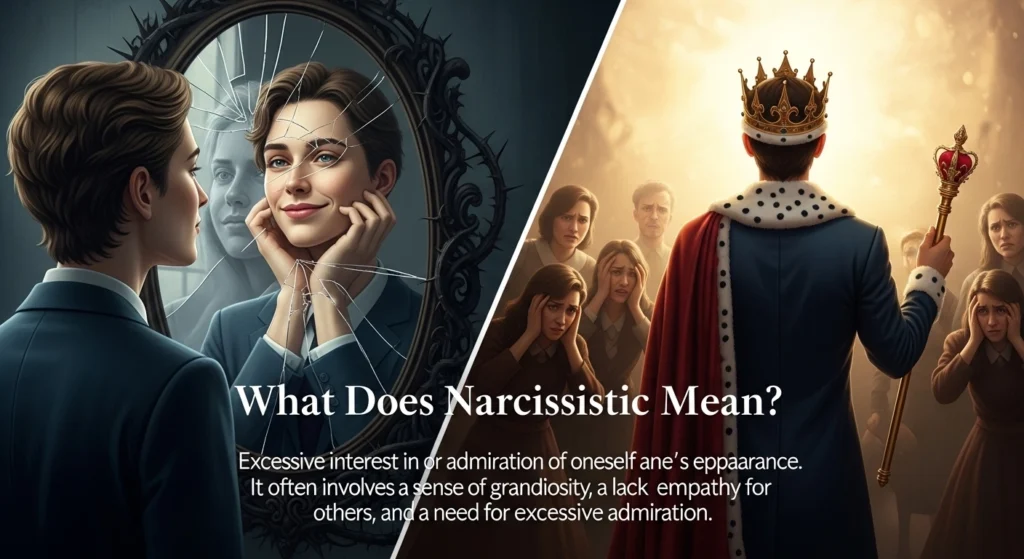
In simple terms, “narcissistic” refers to someone who has an excessive sense of self-importance, a strong need for admiration, and a lack of empathy for others. It can describe a personality trait, a mindset, or a behavior pattern.
⚡ Quick Answer
Narcissistic means showing extreme self-centeredness, often putting your own needs and desires above others. It can also describe someone who craves attention and admiration excessively.
📚 Meaning in Different Contexts
In Texting and Messaging
When someone is described as narcissistic in texting, it usually refers to self-centered messages. For example:
- Constantly talking about themselves without asking about you.
- Sending texts to brag or show off achievements.
- Expecting immediate replies to their messages but rarely reciprocating.
Example:
“I just got promoted again 😎. So, when are we celebrating me?”
This shows a focus on self rather than mutual conversation.
In Love and Relationships
In relationships, a narcissistic partner may:
- Seek constant validation and attention.
- Struggle to empathize with their partner’s feelings.
- Manipulate situations to always come out on top.
Example:
A narcissistic partner may dismiss your emotions by saying:
“You’re overreacting; it’s all about me.”
Recognizing narcissism in love helps protect emotional well-being and set boundaries.
In Slang and Casual Language
In casual speech, “narcissistic” is often used to tease someone who seems overly proud or self-absorbed.
- Example: “Wow, you’re so narcissistic, posting selfies every hour!”
Here, the term is less clinical and more playful or observational.
On Social Media Platforms (TikTok, Instagram, Snapchat, etc.)
Social media often amplifies narcissistic tendencies:
- Frequent selfies or overly curated posts.
- Seeking likes, comments, and validation constantly.
- Comparing oneself to others and showing off wealth or lifestyle.
Example Caption:
“Self-love is my full-time job 😘 #NarcissisticVibes”
While some posts are playful, repeated self-centered behavior can signal deeper narcissistic traits.
Spiritual or Symbolic Meaning
In spiritual contexts, narcissism can symbolize ego dominance or self-focus that hinders personal growth. It may be seen as a lesson in balancing self-love with empathy and humility.
Numerology or Cultural Meaning
Culturally, narcissism is often associated with figures who seek power, recognition, or admiration. In numerology or personality analysis, excessive narcissistic tendencies can reflect an imbalance between self-expression and empathy for others.
🧠 Examples & Usage
| Context | Example | Meaning |
| Texting | “I can’t believe everyone missed my post 😩” | Seeking attention |
| Romance | “You should be grateful I’m with you” | Self-centered in love |
| Social Media | Selfie with caption “Looking perfect as always” | Craving admiration |
| Slang | “He’s so narcissistic” | Teasing or describing ego |
Context changes meaning: playful on social media, serious in relationships, or descriptive in psychology.
❓ Common Questions About Narcissistic
1. What does narcissistic really mean?
It describes someone who is overly self-focused, craves attention, and may lack empathy for others.
2. Is narcissistic positive or negative?
Generally negative, especially in relationships. However, mild self-confidence isn’t harmful—it becomes narcissism when it’s extreme and self-centered.
3. Is narcissistic romantic?
Usually not. Narcissistic people may struggle with romantic empathy, making relationships challenging.
4. How should someone reply to narcissistic behavior?
- Set clear boundaries.
- Avoid engaging in constant validation.
- Seek support if manipulation occurs.
🏁 Conclusion
In simple terms, narcissistic means being self-centered, craving attention, and showing little empathy for others. Whether seen in text messages, social media, or relationships, understanding narcissism helps you recognize behaviors, set boundaries, and respond appropriately. Now, when you hear the term narcissistic, you can confidently explain what it means in any context.
