

The term “censure in Congress” has been trending lately because of high-profile political debates, viral news clips, and social media discussions involving lawmakers. When Congress publicly criticizes one of its own members, people often rush to Google to understand what censure really means, how serious it is, and what consequences it carries.
Censure in Congress means a formal statement of strong disapproval issued by the U.S. House of Representatives or the Senate against one of its members for misconduct or behavior deemed inappropriate. It is an official punishment, but it does not remove the lawmaker from office.
⚡ Quick Answer
Censure in Congress is a formal and public reprimand of a member of Congress for misconduct. It expresses official disapproval but does not remove the person from their position.
📚 What Does Censure Mean in Different Contexts?
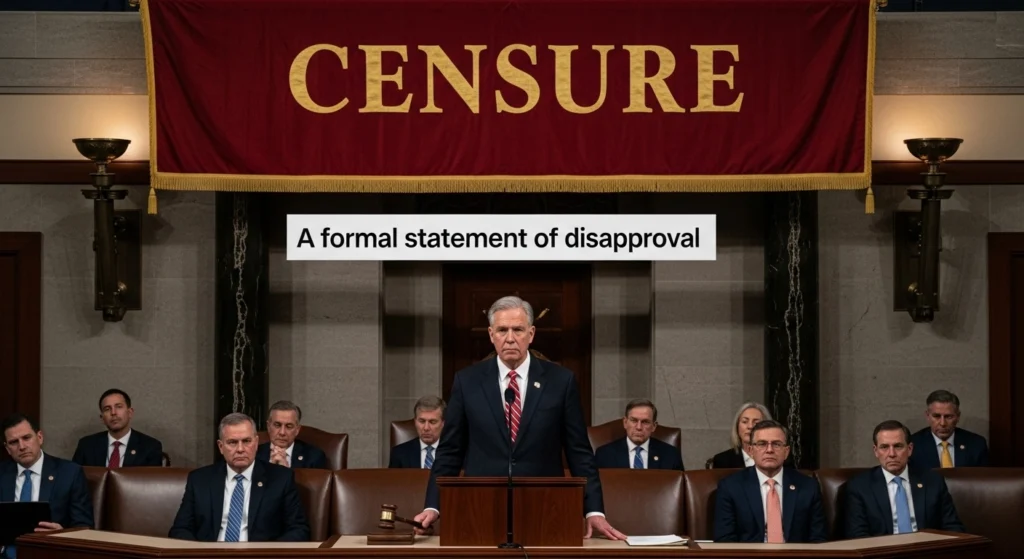
What Does Censure Mean in Congress (Political Meaning)
In Congress, censure is one of the strongest disciplinary actions available short of expulsion.
Key points:
- It is voted on officially by the House or Senate
- It becomes part of the public record
- The censured member may be required to stand while the resolution is read aloud
- The member keeps their seat and voting power
Important:
Censure is serious, but it is symbolic, not criminal.
What Does Censure Mean in Texting and Messaging
In everyday texting or messaging, “censure” is rarely used. When it does appear, it usually keeps its formal meaning.
Example:
- “The committee might censure him for breaking the rules.”
👉 In casual chats, people usually replace it with words like “call out,” “criticize,” or “reprimand.”
What Does Censure Mean in Love and Relationships
In relationships, censure is not a romantic term.
If used, it means:
- Strong disapproval
- Harsh criticism
- Formal judgment
Example:
- “She felt censured by her partner’s constant criticism.”
🔴 This usage carries a negative emotional tone.
What Does Censure Mean in Slang and Casual Language
Censure is not slang. It is a formal word often associated with:
- Politics
- Law
- Institutions
- Professional settings
Casual alternatives include:
- Call out
- Shame
- Scold
- Criticize
What Does Censure Mean on Social Media (TikTok, Instagram, X)
On social media, censure is mostly used in:
- Political posts
- News commentary
- Educational content
Example caption:
- “Congress voted to censure the lawmaker after the controversy.”
Creators often explain it because many users don’t know the meaning, which is why it trends.
Spiritual or Symbolic Meaning of Censure
Spiritually or symbolically, censure can represent:
- Moral accountability
- Public correction
- A warning to change behavior
It symbolizes being held responsible rather than being forgiven or punished harshly.
Numerology or Cultural Meaning of Censure
There is no numerological meaning linked to censure.
Culturally, it reflects:
- Ethical standards
- Social accountability
- Collective judgment
In democratic societies, it acts as a public warning rather than exile.
🧠 Examples & Usage
Real-Life Political Example
- “The House voted to censure the representative for ethics violations.”
Casual Explanation
- “Censure is like Congress officially saying, ‘We strongly disapprove.’”
Social Media Example
- “Not expelled, but censured—here’s what it really means.”
How Context Changes Meaning
| Context | Meaning |
| Congress | Formal political reprimand |
| Workplace | Official disciplinary criticism |
| Relationships | Harsh disapproval |
| Social Media | News-based or educational |
❓ Common Questions About Censure in Congress
What Does Censure in Congress Really Mean?
It means Congress has formally condemned a member’s behavior without removing them from office.
Is Censure Positive or Negative?
Negative. It publicly damages reputation but stops short of removal.
Is Censure Romantic?
No. Censure is not romantic and carries a serious, critical tone.
How Should Someone Respond to a Censure?
A censured member may:
- Publicly apologize
- Defend their actions
- Accept responsibility
- Move forward politically
There is no legal requirement for a response.
Is Censure Worse Than Reprimand?
Yes.
Censure is stronger and more formal than a reprimand but weaker than expulsion.
🏁 Conclusion
In simple terms, censure in Congress is an official and public way of saying a lawmaker’s behavior was unacceptable. It carries serious reputational consequences, but the member remains in office.
Now that you understand what censure means in Congress, you can confidently follow political news without confusion or misinformation.
