
Have you ever wondered how to find the mean and why it’s such a common term in math, statistics, and even daily conversations? From school assignments to interpreting data, people are constantly searching for simple ways to understand the mean.
The mean, often called the average, is a way to summarize a set of numbers with a single value that represents the “center” of the data. It’s easy to calculate and widely used in math, science, and even casual texting or social media. Understanding it can help you make smarter decisions, solve problems faster, and explain numbers clearly.
⚡ Quick Answer
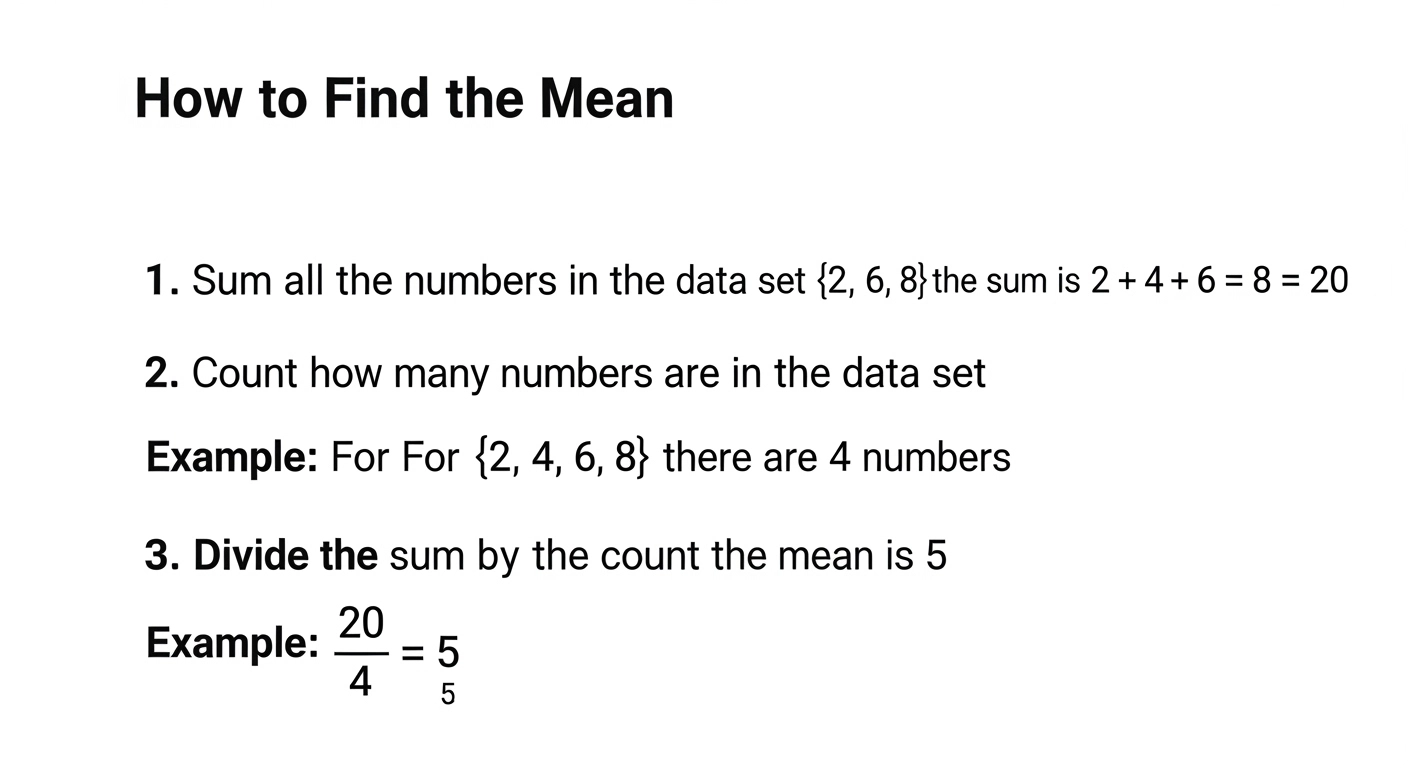
The mean is the sum of a group of numbers divided by the total number of numbers. In simple terms:
Mean = (Sum of all numbers) ÷ (Total numbers)
For example, if your numbers are 2, 4, and 6, the mean is (2 + 4 + 6) ÷ 3 = 4.
What Does “Mean” Really Mean in Different Contexts
In Texting and Messaging
In everyday texting, mean usually refers to the mathematical concept less often. Most people might ask someone to calculate the mean of numbers when sharing homework, finances, or statistics.
Example:
“Hey, can you find the mean of these test scores? 90, 85, 78, 92.”
Reply: “Sure! Sum = 345, divide by 4, mean = 86.25.”
In Love and Relationships
While mean isn’t romantic in itself, numbers and averages sometimes come up in conversations like planning budgets, tracking expenses, or even comparing shared activities.
Example:
“If we spend $50, $70, and $80 on dates, the mean cost is $66.67 per date.”
In Slang and Casual Language
Be careful! In casual speech, “mean” can also describe attitude: being harsh or unkind. But in math or educational contexts, it always refers to the average.
Example:
“Her mean score on exams was 88” → purely numerical.
“She’s being mean to me” → attitude, not math.
On Social Media Platforms (TikTok, Instagram, Snapchat)
Social media posts often include numbers: followers, likes, scores, or stats. The mean helps summarize these numbers efficiently.
Example:
- TikTok caption: “Average likes on my last 5 videos = 1,200”
- Instagram story: “Mean score in my quiz = 92!”
This shows audiences a simple snapshot instead of listing all numbers.
Spiritual or Symbolic Meaning
In numerology or spiritual contexts, mean usually doesn’t carry symbolic meaning. However, averages can symbolize balance or fairness, since the mean represents a central point.
Numerology or Cultural Meaning
Similarly, in most cultures, the mean is valued for fairness and equal representation. For example, calculating average scores in schools or competitions ensures everyone is treated objectively.
🧠 Examples & Usage
Here’s a step-by-step example to make it crystal clear:
Example 1 – Basic Calculation:
Numbers: 5, 10, 15, 20
- Add all numbers: 5 + 10 + 15 + 20 = 50
- Count total numbers: 4
- Divide sum by count: 50 ÷ 4 = 12.5
✅ Mean = 12.5
Example 2 – Texting Use:
Friend: “Can you find the mean of my game scores? 12, 18, 20, 10.”
You: “Sum = 60, divide by 4, mean = 15.”
❓ Common Questions (FAQ)
Q1: What does finding the mean really mean?
A: It means calculating the average value of a set of numbers by adding them up and dividing by how many numbers there are.
Q2: Is the mean positive or negative?
A: The mean can be positive, negative, or zero, depending on the numbers.
Q3: Is finding the mean romantic?
A: No, it’s purely mathematical or practical; it doesn’t carry a romantic meaning.
Q4: How should someone reply if asked to find the mean?
A: Follow the formula: Sum ÷ Total numbers, then provide the answer clearly.
🏁 Conclusion
Finding the mean is simple, useful, and important in many areas of life. Whether for school, work, social media, or daily decisions, knowing how to calculate it gives you a clear, quick way to understand numbers.
Now, whenever someone asks, “How do you find the mean?” you can confidently explain it and even show examples in texts, posts, or real-life situations.
